The sound of steady rain woke me one recent midnight, and I imagined monsoon clouds irrigating the land as they always do this time of the year in the home country. It’s the kind of soothing sound that makes a person sink deeper into bed, an announcement that the season has simply arrived and is doing its thing as scheduled.
But then I sat up and looked out the window and realized I was in California where, as the song goes, it never rains. At least not with the same intensity as in other places. I realized the sound I mistook for rain was the hum of the electric fan.
I miss the rain. The tropical rain. The gentle rain that’s called bed weather that makes you want to stay indoors, drinking hot chocolate or sipping soup while reading a good book. It’s the kind of rain welcomed as a blessing, one that slakes parched earth.
But there’s also the brutal kind of rain that has ravaged some parts of the U.S. this summer: Texas, North Carolina and New York. The stories that came out of these places are simply heartbreaking and devastating, the storm coming like a thief in the night. The Washington Post reports that the US is unprepared for the kind of rainfall that it’s been receiving, which is “supercharged by climate change, rendering existing response plans inadequate.”
On the other side of the Pacific, storms are also hammering at the Philippines, which gets visited by at least 20 typhoons each year. You would expect that since big typhoons come with regularity, there would be some sort of preparedness. But that is never the case, and always, the Philippines seems to be perennially caught unaware by these annual visitors. So Americans have a lot in common with Filipinos, and really, solidarity and sympathy are in order.
In the Philippines, people have gotten so used to typhoons, that the news media have posted bizarre photographs and stories of them smiling and laughing while wading through waist-high water during a lull in the onslaught of Severe Tropical Storm Crising (International name Wipha). One couple even pushed through with a wedding, with complete entourage, walking down the aisle in leg-deep floods, making for memorable event indeed.
Life goes on, and often there is no other option but to take things good-naturedly. Doesn’t mean the pain, hardship and loss do not exist or are forgotten. Most Filipinos have at some point and in some form experienced the assault of these extreme weather disturbances. I and members of my family have gone through many versions of such difficulties, which are nothing compared to what others have experienced. The situations are almost always the same—getting forced off the road by rising floodwaters, leaving us stranded for hours or even days, floods rushing into and damaging homes and belongings.

Try as we may to avoid them, we find ourselves in such situations. In my former life as a news reporter, I remember returning from a news coverage somewhere North of Manila and heavy rains suddenly transforming the highway into one big ocean. All cars were forced to halt where they were, while I had to seek shelter at the nearest town hall, sleeping atop an office desk, and at dawn trying to reach higher ground by renting a boat that took me through flooded fishponds so I could file my story. I had to leave the vehicle and its driver behind. That was decades ago and the storms continue to come, this time more ferociously. Meanwhile, we accept climate change as a reality and do our part to mitigate its effects, no matter how small the effort.
* * *
Being where I am on the other side of the Pacific spares me the agony of flooded streets and lost belongings and enables me to ponder different perspectives on rain.
Rain is sacred to some people and places. It nurtures crops and feeds people. There’s this amazing version of the song “Africa” (Toto), an acapella cover by the Los Angeles choir Angel City Chorale, whose members in the first two minutes mimic a thunderstorm using only their hands (with recorded thunder in the background for dramatic effect). The song itself is a celebration of a continent, rain and all.
Rain as white noise is all over YouTube, promoted as a sleeping pill of sorts, an audio-visual relaxant. But then again, I could be in danger of mistaking rain sounds for other things, too, like the Instagrammer Jwoww_21 who hears lumpia frying while being lulled to asleep.
In general rain songs are sad, usually about heartbreak and separation. One exception is a Filipino classic called Tuwing Umuulan at Kapiling ka (When it rains and I’m with you), which likens the torrents to passion. This song was sort of ingrained in my memory after a professor I had in college assigned us the task of listening to it and analyzing its message.
Dedicated to Filipinos overseas is a song called Raining in Manila by the band Lola Amour. The lyrics are in Taglish (combination of the local language Tagalog and English) and the tune is bouncy. The official music video can be watched here, but I heard it’s been criticized for portraying poverty porn. I found it funny and creative, and you’d have to be Filipino or know Filipinos to spot the symbolisms. At any rate, the band’s lead singer Pio Dumayas graciously walks the viewer through the song’s lyrics and explains what he and the other composers meant when they wrote it. It’s also a lesson in Tagalog or Filipino, the official language, for those learning the language.
Even non-Filipinos will appreciate Pio’s clarification because he does it in flawless English. Imagine a college professor asking students these days to explain the song, and all they have to do is watch Pio on YouTube.
Anyway, the next time I mistake the electric fan for rain, I will think of Lola Amour, and remember the rain where it pours the heaviest.
—
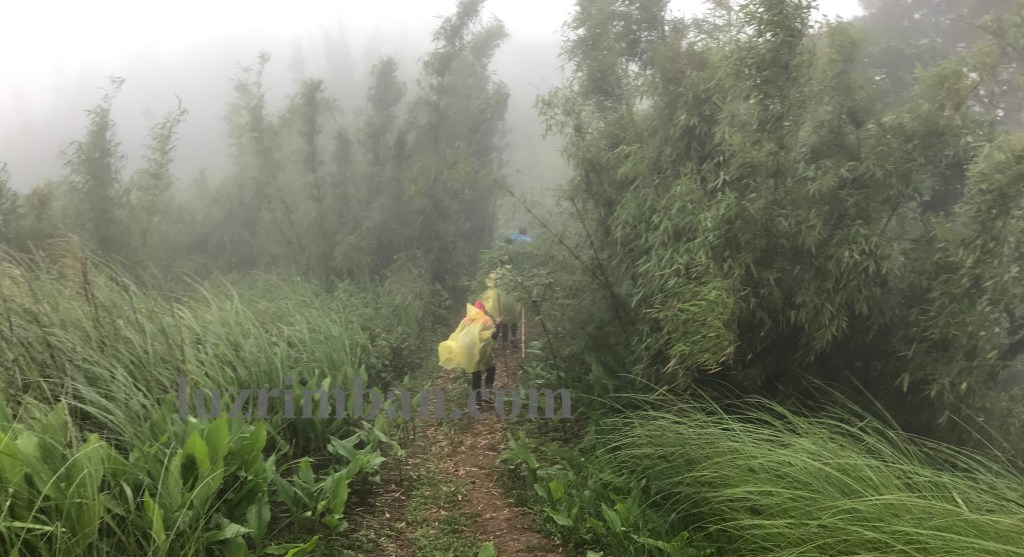
- The featured photo at the top is from a hike I took part in a few years ago, in Tanay, a town west of Metro Manila. The trek up took us half a day and the weather was fine but quickly changed on the way down. The steep path turned slippery, but guides provided us with walking sticks and raincoats.
- The second photo is from Noveleta in Cavite back in 2016, when monsoon rains inundated the road and what used to be fishponds beside it, turning into an ocean. Scenes like this repeat themselves every few years. ###.
 On the road
Leave a comment